
Healthy Hair Care Saves Your hair
Haircare for healthy hair growth & prevent hair loss: There are several ways to maintain healthy hair growth with optimal nutrition & good hair care. Improper hair care can be a factor in losing hair quality; hair fall out, and thinning hair.
Nu Hair’s expert in Dallas, Texas, advises consulting your doctor as you see excessive hair loss.
Easy Hair Care
How to care for your hair for healthy hair growth? Easy hair care starts with good natural products and good healthy living. For example, green tea and saw palmetto have demonstrated the therapeutic potential for hair loss treatment.
Doctors recommend using natural hair care and healthy common sense habits to promote growth, keep hair beautiful, and prevent loss.
- Maintain a nutritious, healthy diet.
- Practice good hygiene.
- Proper hair styling is essential to robust hair growth.

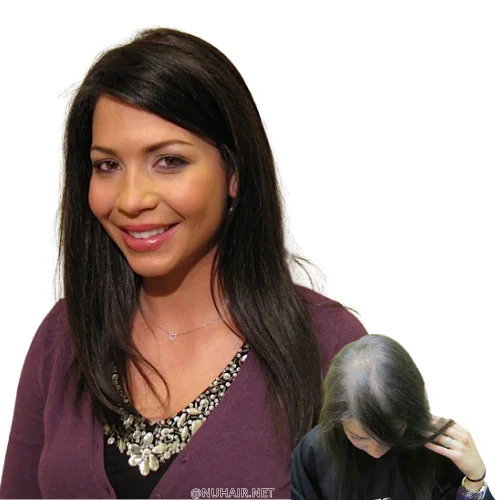
*Photos are our Transitions members’ & Nu Hair of Texas hair restoration results for hair loss, nonsurgical hair replacement, wigs, and MEp90 laser hair growth therapy. Real Clients. Real Results.
Choosing Treatments
DRY HAIR Problem
What causes dull, dry, brittle hair? Dermatologists say that hair loss can start with hair breakage, hair that is dry and brittle. Hair that looks frizzy and dry looks poor and damaged.
The cause may be due to using chemical dyes and permanents. In addition, the harsh chemicals destroy the cuticle and leave hair wide open to injury, and consequently, hair falls out. Using chemicals often without a trained specialist causes hair to dry and become brittle.
Likewise, a hot blow dryer close to the hair is usually similar to sun damage to the skin.
10 Hair Care Tips
Best haircare tips to increase hair growth & prevent hair loss:
- One of the most straightforward tips is to use mild shampoos and conditioners for damaged hair and hair loss or thin hair.
- Avoid using the following: perms or hair straightening, bleaching, dyeing, hot curling irons, tight braiding, and hair dryers set on a high setting. Indeed, get your hair treatment done by an experienced professional.
- Avoid tight braiding and ponytails. The pull causes the hair follicles to become inflamed. It results in damage to the roots and usual permanent hair loss.
- While shampooing your hair, use the pads of your fingers, not fingernails on the scalp.
- Dry your hair naturally by patting it with a towel. If necessary, set your blow dryer to a cool setting. Let ends of the hair dry on their own to prevent hair ends from splitting or breaking.
- Using a stiff bristle brush can snap off your hair. Instead, use a brush with ball-tipped bristles. And use a wide-tooth comb for wet hair.
- When combing out tangles, start from the ends of the hair and work your way up. Use a spray-on conditioner all over the hair.
- Choose a short hairstyle or a layered cut; it can make your hair look thicker.
- The sun is just as damaging to hair as the skin. Protect your hair poolside or at the beach: with a good leave-in conditioner with sunscreen. And you better wear a hat.
- After swimming, apply a quality clarifying shampoo with the main ingredient E.D.T.A. The ingredient will neutralize the chlorine, preventing the swimmer’s green color. Chlorine dries hair and skin. Use a good conditioner with protein for a protective outer layer, to repair split ends, and to have a healthy hair look.

8 Natural Haircare Suggestions
Haircare for Healthy Body & Beautiful Hair:
- Natural hair care tip also includes stress reduction. Use some form of meditation or other relaxation techniques if you are pulling your hair.
- Eat a well-balanced, nutritious diet with a proper amount of protein. Salmon and nuts are protein, and their omega-3 fats help create a healthier scalp.
- Vitamin B6, Zinc, and azelaic acid are combined to inhibit the activity of 5-alpha-reductase and control excess dihydrotestosterone (D.H.T.).
- Starvation and fad diets lead to brittle hair and hair loss.
- Get medical advice for any skin abnormalities on your scalp.
- Hair can stretch up to 50% of its length while wet without breakage; however, while dry, the hair will break before it stretches 25% of its size. It is best to keep a wide-toothed comb within your shower to detangle & seal split ends while using a low pH (3.5 to 5.5 acidic) conditioner.
- Specific hairstyles & cuts make hair look better for thin-density hair. Short hair and a single-length look their fullest.
- Use conditioners with polymers (look for polyvinylpyrrolidone on the label) for curly hair to make it manageable. Curly hair is more likely to break when a brush pulls the curls.
MEp90 laser therapy
Hair care for healthy hair growth. MEp90 laser hair therapy is a hair regrowth treatment. Are you suffering from hair thinning and hair loss? Laser hair therapy may be your hair regrowth solution.
Laser treatments promote hair growth for longer, stronger hair strands and stop hair loss progression. MEp90 is a proven laser hair loss treatment for pattern hair loss thinning (Androgenetic Alopecia).

Indeed, MEp90 laser hair therapy has received F.D.A. approval (Approved #K091496) as hair growth therapy & hair loss treatment. Most significant is the F.D.A. oversight of the MEp90 Laser Hair Therapy clinical trial.
Each subject received 36 treatments at 20 minutes duration over 18 wks. Results were conducted at 10-weeks (20 treatments) and 18-weeks (36 treatments) levels. The collected clinical data shows the following:
- After 20 treatments (10 weeks), 92% of subjects had increased hair counts of >+10%, with 57% showing an increase of 30%.
- 98% of subjects showed significant stabilization of the rate of hair loss.
- After 36 treatments, 97% of subjects had an increased hair count of >+ 20%. 89% of all demonstrated an elevated hair count of >+30%, with 57% showing an increased hair count of >+50%.
RESOURCE
- Efficacy and safety of a low-level laser device in the treatment of male and female pattern hair loss
- Low level laser therapy and hair regrowth
- Hair Cosmetics
We believe that your hair has the power to make you happy and confident. Our goal is to make that possible for everyone in the world.
Nu Hair of Texas center is in North Dallas, just off Preston Rd and 635 Freeway, close to Addison, and minutes away from Allen, Arlington, Frisco, Garland, McKinney, Richardson, and Plano, Texas area. Our central location is only 30 minutes drive from Southlake & Fort Worth.
Contact Nu Hair of Texas for your private consultation. And discover easy ways to get your beautiful hair back and tips to optimize your hairstyle.